Saturday, June 17, 2017

Globetrotting for Ceramics

I've been doing a lot of travel the past few years and have taken a lot of photos along the way of any historical ceramics I came across.  I plan on sharing some of these going forward.

Here is a sample of some of the pots I found on my trip to Dublin 2017.


 photo IMG_0991_zpsgj5gpvrd.jpg  photo IMG_0977_zpsredrssys.jpg
 photo IMG_0960_zpssqwpdxng.jpg  photo IMG_0952_zpsrggtmgzo.jpg  photo IMG_0943_zpsp3eplpux.jpg
Just a tease.

Labels: , , , , , ,

Monday, August 08, 2011

Bowls in Medieval England

Bowls have been around for an incredible amount of time. You'd think it was easy to document certain shapes for whatever culture, but it's been a little on the tricky side. I think what happens is, especially with pottery, that pieces tend to get handed down or, if they break in use, they are mashed up and used for the garden or whatever sideline the person decided at the time. Broken pottery has a variety of uses, from sharpening knives to using the ground bits to help with paving a road (like sand).

Also, a bowl doesn't really have many different shapes to it. You can belly it out more or have a straighter wall, play with the lip or the foot, but it is pretty much the same more or less.

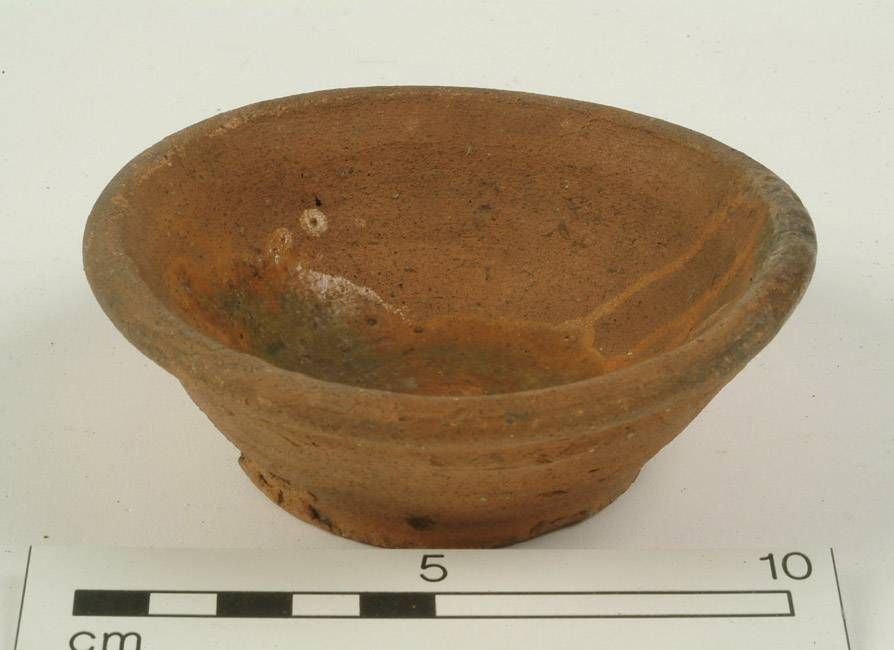
Here is a Medieval bowl, late 11th-mid 14th century bowl from the Museum of London.


Some of the details on this one.

Material: ceramic; earthenware
Measurements: H 43 mm; DM (rim) 108 mm
Museum Section: Medieval
Summary: London-type ware? flared dish. Splash-glazed internally.

Labels: , ,

Saturday, June 11, 2011

Dishes in Medieval Oxford

The plate is an important part of any meal, the centerpiece of the modern table, however, dishes were used earlier on as well. A dish is usually a shallow piece with taller more vertical walls than a standard plate. I suppose you could compare it to dog food dishes of today in some cases.

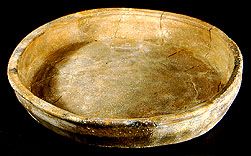
This example below is from the Ashmolean Museum:


*Common Name Early Medieval Oxford ware
*Class Dish
*Height 56-65mm
*Identifier PW45
*Production centre dispersed industry to the north west of Oxford
*Distribution local
*Use baking and preparation of food
*Date Late 12th - early 13th century AD
*Published in Mellor in Allen 1994, Fig 70 no 1, 328
*Historic context ditch in rural hamlet

In the Period, plates had multiple uses. They weren't just to sit on a table, but more to be used in preparation of cooking or also used in the process of baking.

Labels: ,

Sunday, December 19, 2010

Cauldron Cooking in Medieval England

cauldron, caldron [ˈkɔːldrən]
n
(Cookery) a large pot used for boiling, esp one with handles
[from earlier cauderon, from Anglo-French, from Latin caldārium hot bath, from calidus warm]
Collins English Dictionary – Complete and Unabridged © HarperCollins Publishers 1991, 1994, 1998, 2000, 2003

********************

caul·dron also cal·dron (kôldrn)
n.
1. A large vessel, such as a kettle or vat, used for boiling.
2. A state or situation of great distress or unrest felt to resemble a boiling kettle or vat: a cauldron of conflicting corporate politics.

[Middle English, alteration of cauderon, from Norman French, diminutive of caudiere, cooking pot, from Late Latin caldria, from feminine of Latin caldrius, suitable for warming, from calidus, warm; see kel-1 in Indo-European roots.]

*****************

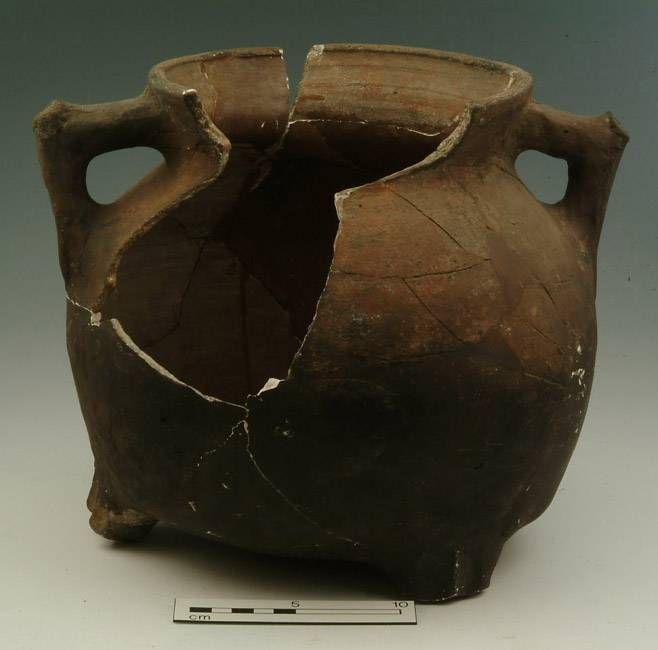
While looking over the Museum of London.org site, I came across this lovely Cauldron. I'd never seen this one before and this is one of those pots that I am excited to see because, while it is fairly broken, it shows different handles and some fairly modern looking feet. I spoke briefly in a previous post about pipkins and tri-pod pipkins, so the cauldron, at least this one, is one step above a pipkin. It's like the father of cookpots. This one has feet and it's big. It's handles on either side really show that this thing was ment to be full of liquid and hauled up. It probably had a lid by the deep gallery it has (potter term... inside lip I guess you would call it). There wasn't one on the site, but I would assume there was one by the size and because it is a cauldron (it's cooking use, there is a need for a lid).

Accession number: 18931
Collection place: London
Production date: Medieval; late 13th-mid 14th century
Material: ceramic; earthenware
Measurements: H 240 mm
Museum Section: Medieval
Summary: Largely reconstructed London-type ware cauldron with opposed, angular loop handles, glazed internally.
Location: Object stored at Mortimer Wheeler House (Ceramics and Glass store)
Category: Medieval glazed ware.
Sub-category: London-type ware.


Labels: , , , ,


 TOP 

©2002-8 Mercy Neumark. All Rights Reserved.
No part of this website may be reproduced without express written permission of the author.
RakuRakuTei.com | P.O.Box 9957, Canoga Park, CA 91309 |
mercy@rakurakutei.com